
General Enquiries
In addition to browsing this website, we encourage you to register your contact information now to receive our latest workplace heatstroke prevention information.
- Register through the online form: https://bit.ly/4jmtbKl (Chinese version only)
- Register through the OSH 24-Hours Hotline for Prevention of Heat Stroke:
 WhatsApp 9317 0987 (Chinese version only)

The hot and humid summer in Hong Kong poses an increased risk of heat stroke to employees
working outdoor or in indoor environments that lack air conditioning systems. Therefore, employers are required to conduct risk assessments on the heat stress of employees at work, by considering the various heat stress risk factors (including working environment, workload and personal factors, and take appropriate measures for prevention of heat stroke and help employees to cool down the body, and arrange appropriate rest breaks in times of Heat Stress at Work Warnings. The employees take measures to prevent heat stroke arranged by their employers at work, to safeguard their own occupational safety and health and reduce the risk of heat stroke.
The Labour Department (LD) launches the enhanced Heat Stress at Work Warning system with effect from August 2026. In addition to using the Hong Kong Heat Index measured by the Hong Kong Observatory at King’s Park , the measured temperatures generally over Hong Kong, and the “Extreme Hot Weather” special prompt as the basis for issuing the amber, red and black warnings, LD enhances the system by adding the data measured at the other nine monitoring stations of the Hong Kong Observatory and revises the issuing criteria of the system to increase its sensitivity and coverage, thus strengthening the protection of health of employees at work.
Following the release of Hong Kong Heat Index data from 10 locations across Hong Kong on Hong Kong Observatory’s website starting from April 2026, the Labour Department will make good use of the data from other 9 monitoring stations (including Hong Kong Observatory, Chek Lap Kok, Happy Valley, Kau Sai Chau, Kowloon Bay, Sha Tin, Wetland Park, Wong Chuk Hang and Beas River) in addition to using the Hong Kong Heat Index measured at King’s Park. This expansion broadens the coverage of the system to include more remote areas and provides an additional protection for employees.
The Labour Department will issue the Heat Stress at Work Warning based on the Hong Kong Heat Index measured by the Hong Kong Observatory at King’s Park and incorporate additional data measured at the other nine monitoring stations of the Hong Kong Observatory into the issuing criteria. If four or more out of the other nine monitoring stations for Hong Kong Heat Index indicate that the heat stress situation over many places in Hong Kong reaches certain level, the corresponding Heat Stress at Work Warning will also be issued even if the index at King’s Park does not reach that level. For example, as illustrated below:
Pillar 1
- The Hong Kong Heat Index at King’s Park station is 29 (below the level of 30 for issuing Amber Heat Stress at Work Warning), but four or more other stations reach 30, the Amber Heat Stress at Work Warning will still be issued.
- The Heat Index at King’s Park station is 31 (below the level of 32 for issuing Red Heat Stress at Work Warning), but four or more other stations reach 32 or above, the Red Heat Stress at Work Warning will be triggered.
The enhanced system will introduce two new conditions for triggering different levels of HSWW.
First, as illustrated in Pillar 2, when the “Extremely Hot Weather” Special Alert issued by the Hong Kong Observatory (HKO) is in effect, the monitoring threshold for triggering a higher level of warning will be lowered, enabling the early activation of a higher level of warning.
Second, as illustrated in Pillar 3, when the measured temperatures generally over Hong Kong reach 35℃ or above, apart from lowering the monitoring threshold for triggering a warning, the warning level will be raised by one level automatically (i.e. from Amber Warning to Red Warning, or from Red Warning to Black Warning), in order to alert the public of the health risks of heat stress when working under abnormally high temperatures.
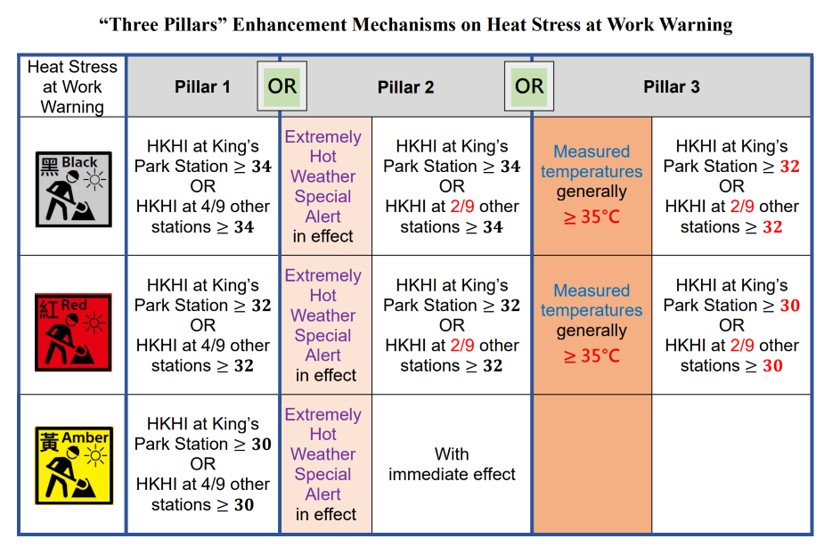
Notes:
- The Heat Stress at Work Warning has three warning levels, coded Amber, Red, and Black, indicating that the level of heat stress is high, very high, and extremely high respectively.
- The Hong Kong Heat Index (HKHI) is an index integrating important effects from temperature, humidity, sunshine, and wind speed. “HKHI at King’s Park Station” refers to the index measured at King’s Park by HKO; “HKHI at other stations” refers to data obtained from the nine other HKO stations for measuring HKHI. “HKHI at 4/9 other stations” indicates the index obtained at four locations out of the nine other HKHI stations, and “HKHI at 2/9 other stations” indicates the HKHI at two locations out of the nine other stations.
- “Measured temperatures generally ≥ 35°C” refers to air temperature values measured at various locations, covering about 40% of HKO’s weather stations for monitoring air tempurature, are generally over Hong Kong reach 35°C or above.
The Heat Stress at Work Warning can dynamically reflect real-time heat stress levels across Hong Kong, promptly reminding employers and employees to take appropriate heat stress preventive measures according to different warning levels. It can also help ease employers’ efforts in monitoring the heat stress levels in workplaces over extended periods.
If employers and employees believe that, due to the special circumstances of the workplace (e.g. geographical location, working environment), the Heat Stress at Work Warning does not fully reflect the risk of heat stress posed to employees at work, the employers have the responsibility to make assessment accordingly, such as seeking occupational health professionals to measure the Wet Bulb Globe Temperature (WBGT) index at the workplace for evaluating the level of heat stress faced by the employees, and taking corresponding preventive measures based on the results to reduce the risk of heat stroke at work.
The Heat Stress at Work Warning system is a territory-wide alert system. The issuance of different levels of Heat Stress at Work Warnings at different regions will obviously cause confusion to stakeholders when receiving the information. The Labour Department (LD) will consider the overall situation of Hong Kong and strive a balance to minimise the impact of an extreme meteorological data from a single specific location. LD launches the enhanced the Heat Stress at Work Warning system with effect from August 2026. In addition to using the Hong Kong Heat Index measured by the Hong Kong Observatory at King’s Park, the enhanced system will incorporate additional data measured at the other nine monitoring stations of the Hong Kong Observatory , the measured temperatures generally over Hong Kong, and the “Extreme Hot Weather” special prompt as the basis for issuing criteria of the Heat Stress at Work Warning. Such enhancements allow the system to have a wider coverage and to more comprehensively and appropriately reflect the heat stress levels and health risks due to weather at different workplaces.
The new arrangements enhance the sensitivity and coverage of the Heat Stress at Work Warning system, but will not impose additional work for employers and employees. Employers and employees can still conduct heat stress risk assessment according to the Guidance Notes on Prevention of Heat Stroke at Work published by the Labour Department and take heed of the level of Heat Stress at Work Warning, coded Amber, Red and Black, and implement the required preventive measures according to the risk assessment results to safeguard the occupational health of relevant employees.
The Labour Department has revised the Guidance Notes on Prevention of Heat Stroke at Work (Third Edition, August 2026), detailing the new criteria for issuing Heat Stress at Work Warning in relevant sections. Other arrangements, (including the risk factors to be considered when conducting heat stress risk assessment and the corresponding control measures recommended) remain unchanged. In general, if there are no significant changes in heat stress risk factors (including environmental, work, and personal factors) compared with previous assessment, the results remain valid. However, a fresh risk assessment should be conducted if the circumstances previously considered have substantial changes.
It can be calculated by using the “Rest Time Calculator” on the webpage.
For details, please refer to the Guidance Notes on Prevention of Heat Stroke at Work issued by the Labour Department, in particular, the Workplace Heat Stress Risk Assessment Form in Appendix 2, Physical Workload Categories and Examples in Appendix 1 and Rest Arrangements for Outdoor Work in Times of Heat Stress at Work Warning in Appendix 4 of the Guidance Notes.
In general, the physical demand can be determined by the physical activities and the carrying load at work. The following are the four levels of physical workload categories and examples.
Light physical workload
Job tasks mainly involve:
- Light arm and leg work while sitting or standing, such as
- writing, typing, drawing, sewing
- driving normal vehicle, operating foot pedal
- inspection, sorting or assembly of light materials
- operating low-powered tools or machines for drilling or sawing work, etc
- Performing light tasks while walking (~2 km/h) on a level, even path
Industry examples
- Security Guard, Traffic Controller, Driver, Property Officer, Warehouse/Logistics Clerk
- Doorman, Tour Guide, Waiter, Waitress, Salesperson, Survey Interviewer
- Telecommunications Technician, Electronic Technician, Engineering Inspector, etc.
Moderate physical workload
Job tasks mainly involve:
- Sustained hand and arm work or working with hand and arm, leg or trunk, such as
- manipulating hand tool for cutting, hammering nails, filing and polishing
- working with pneumatic breaker, plastering or brick laying work
- off-road operation of lorries, tractors or construction equipment
- weeding, hoeing, picking fruits or vegetables
- loading or unloading goods, pushing or pulling lightweight carts
- Walking (~2 to 5 km/h) on a level, even path or walking (~2.5 to 3 km/h) on levelled but irregular ground, or walking (<2.5 km/h) on stable ground uphill with inclination ≤5%
Industry examples
- Chef, Cleaner, Worker Who Sprays Pesticides or Disinfectants, Gardener, Laundry Worker
- Container Operator, Delivery Worker, Postal and Electrical Workers, Warehouse Worker
- Mechanical and Electrical Workers, Painting, Plastering, Aircraft Maintenance Technician
- Construction Machinery Technician, Electrical Engineering Technician, Building Services Technician, Surveying Technician, Renovation Worker
- Rigger, Welder, Plumber, Mobile or Tower Crane Operator, Excavator Operator, etc.
Heavy physical workload
Job tasks mainly involve:
- Intense arm and trunk work with hand tools or machines or carrying heavy object, such as
- shovelling or chiselling work
- mixing, pouring, and compacting concrete using a concrete vibrator
- pushing or pulling heavily loaded hand carts or wheelbarrows
- Walking (~5.5 to 7 km/h) on a level, even path or walking (~3.5 to 5 km/h) on levelled but irregular or unstable ground
- Walking (~2.5 to 3 km/h) uphill with inclination ≤5%) (Carrying with load not more than 10 kg)
Industry examples
- Structural Steel Frame Installer, Porter, Metal Formwork Erector, Concrete Worker, Grouter, Demolition Worker, etc.
Very Heavy physical workload
Job tasks mainly involve:
- Intense activity at rapid pace
- shovelling or digging at a fast pace
- continuously heavy manual handling work or rebar-fixing work
- Walking (~> 7 km/h) on a level, even path or walking (~> 5 km/h) on a levelled but irregular or unstable ground
- Intense activity at rapid pace
Walking (~≥ 3 km/h) uphill with inclination ≥5%) or walking up stairs
Running (≥ 6 km/h)
Industry examples
- Bar Bender and Fixer, Scaffolder, Employee Undergoing Physical Training
If you wish to enquire about the physical workload, please contact the Occupational Safety and Health Branch of the Labour Department at
2559 2297 (auto-recording service available outside service hours) or Whatsapp OSH 24-Hours Hotline for prevention of heat stroke at 9317-0987
Note: The above examples of industries are based on general working conditions of individual occupations and are for reference only. Employers should make reasonable judgments based on the actual job nature of their employees in the risk assessment.
Employers/ Employees should calculate the rest time based on the workload performed during the hour after the Heat Stress at Work Warning is in effect. If two levels of workload are performed in the same hour, the rest time should be calculated according to the dominant workload performed during that hour. When the working time of different levels of workloads are similar, the heavier level of workload should be adopted for the calculation.
Employers may appoint a person who is familiar with the working conditions of the workplace and has basic occupational safety and health knowledge about heat stress to conduct the risk assessment. In addition to considering the various heat stress risk factors (including environmental, work and personal factors), appropriate preventive and control measures should also be recommended based on the different risk factors identified.
If employers cannot take appropriate heat stroke prevention measures according to the Guidance Notes on Prevention of Heat Stroke at Work, due to the unique working conditions and needs of their employees, they could contact the Occupational Safety and Health Branch of the Labour Department at 2542 2172 (auto-recording service available outside service hours) for enquiry, or seek the opinion and assistance of occupational health professionals.
When different levels of Heat Stress at Work Warning are in force, the Hong Kong Observatory will display relevant information on the homepage of its official website and the “My Observatory” mobile application. Employers and employees can also receive details of the Heat Stress at Work Warning by allowing push notifications from the “My Observatory” or “iAM Smart” mobile applications (please refer to the example in Appendix 6). In addition, the Labour Department will issue prompt messages to the public regarding the coming effect of Heat Stress at Work Warning through press releases and various electronic media.
The main purpose of HSWW is to warn about the significant heat stress and health risks posed by the weather in Hong Kong as a whole to employees working outdoors or in indoor environments without air-conditioning systems overall, and to remind employers and employees to take necessary preventive measures to reduce the risk of heat stroke at work.
The establishment of HSWW does not obviate the responsibility of employers to assess safety and health risks in the workplace. If employers and employees believe that, due to the special circumstances of the workplace (e.g. geographical location, working environment), the HSWW does not fully reflect the real-time risk of heat stress posed to employees at work by the weather conditions or environment in the workplace, the employers have the responsibility to make assessment accordingly, such as seeking occupational health professionals to measure the WBGT index at the workplace for evaluating the level of heat stress faced by the employees, and taking corresponding preventive measures based on the results to reduce the risk of heat stroke at work.
After the issuance of a Heat Stress at Work Warning, employers are required to arrange rest breaks according to the workload of employees. Besides “Suspension of work” arrangement, which should be implemented immediately, employers can flexibly arrange for employees to have the recommended rest time during the hour.
The work / rest arrangements recommended in The Guidance Notes on Prevention of Heat Stroke at Work published by the Labour Department are not applicable to work that needs to be performed urgent or emergency work, such as firefighting, emergency rescue, or urgent repair work. Therefore, relevant employers/ responsible persons should develop necessary control measures in advance for employees engaged in such work to prevent heat stroke while performing relevant duties. For enquiry, please contact the Occupational Safety and Health Branch of the Labour Department at 2542 2172 (auto-recording service available outside service hours), or seek the opinion and assistance of occupational health professionals.
Apart from weather conditions, physical work generates heat and increases heat stress. Employers should reduce heat stress during work, as far as reasonably practicable, let employees to have rest break. For instance, employees should let employees performing light to moderate levels of physical work have a minimum of a 10-minute rest break after every 2 hours of work, while employees performing heavy to very heavy levels of physical work should be given at least a 15-minute rest break after every 2 hours of work, to allow employees to recuperate, drink water and cool down their body.
“Heat Acclimatization”means the gradual physiological adaption of the body to enhance the ability to withstand heat stress. If an employee has not worked in a hot environment for more than a month or has never worked in such environment, the employer should arrange a minimum acclimatization period of five days to allow the employee to fully adapt to working in a hot environment. On the first day, the employee’s work in a hot environment should not last for more than 20% of the normal working time in such environment. The working time can then be increased by 20% of the normal working time in hot environment each day until the employee fully adapts and can work normally in the hot environment.
If an employee has not worked in a hot environment for two weeks to one month, the employer should also arrange a minimum acclimatization period of four days when the employee returns to work to allow them to re-adapt to working in a hot environment. On the first day, the employee’s work in a hot environment should not last for more than 50% of the normal working time in such environment. The working time of the employee can then be increased stepwise by 20% of the normal working time in hot environment each day until it returns to the normal working time in hot environment.
Apart from heat acclimatization, if employees have underlying health conditions such as heart disease, hypertension, or are taking certain medications, they may have an increased risk of heat stroke while working in hot environments. If they have doubts about whether their health condition is suitable for working safely in high temperatures, they should consult their doctors, inform their employers of any relevant advice and discuss with them about the appropriate work arrangements.
Enquiries on working environment and facility requirement
from exposure to direct sunlight. Employers/ responsible persons should provide shade or sun-blocking cover, it would be effective to minimize direct sun exposure when covering most parts of the body. Using misting fans indoors can increase humidity in the environment, which can affect the heat dissipation effect. Therefore, misting fans are generally more suitable for use in outdoor environments.
In view of the varying nature and demands of different industries and job positions, employers should implement different control measures for reducing heat stress. For further enquiry, please contact the Occupational Safety and Health Branch of the Labour Department at 2542 2172 (auto-recording service available outside service hours), or seek the opinion and assistance of occupational health professionals.
Also, employers could establish reasonable and mutually agreed heat prevention measures and improve the effectiveness of preventive measures through consultation with employees such as safety committee of the organization.
Generally speaking, in indoor work environments equipped with air conditioning systems, the air temperature and relative humidity can be controlled at 23°C to 26°C and 40 % to 70 % respectively. An air cooler could not achieve such effect.
Adequate air movements through inlets and outlets in an indoor area are essential for natural ventilation. For buildings that rely entirely on natural ventilation, the ventilation openings should be at least 5% to 10% of the floor area to obtain adequate ventilation in summer.
Some examples on ineffective control measures on reducing heat stress from heat sources or heat-generating facilities nearby the working locations:
- No effective devices installed in the kitchen to remove the hot air and humidity generated by cooking process;
- No exhaust device used to remove the hot air generated during gas welding or flame cutting processes;
- No heat shield installed for heat-generating facilities near the working location, which results in higher temperatures in the work location.
Common non-breathable protective clothing includes: coveralls which are impervious to dust or chemicals donned for asbestos removal work or pesticide spraying work; and protective isolation gowns donned by healthcare workers. However, reflective vests and aprons only cover parts of the body, only posed limited impact on heat dissipation, and are not considered as non-breathable clothing.
In addition to the time of rest, the place of rest is also very important. Employers/responsible persons must arrange covered or shaded places for employees working outdoors so that employees can sit and rest. Rest areas should be well ventilated, ideally with air conditioning. If it is not possible to arrange a shaded resting place, it is necessary to give employees a longer rest time to relieve heat stress. In remote workplaces with no electricity supply, employers/persons in charge may consider setting up mobile solar cooling rest stations for the use of relevant employees.
Apart from rest breaks, the location of the rest area is equally important in managing heat stress. Employers / responsible persons should set up or arrange shaded areas for employees performing outdoor work to sit down and rest. Rest areas should have good ventilation or, better still, air conditioning, if available. If shaded rest areas are not available, employees may require longer breaks to alleviate heat stress. In remote and off-grid working locations, employers or responsible persons may consider installing mobile cooling stations for relevant employees to use.
The Occupational Safety and Health Council has developed the “Solar Cooling Kiosk” that provides a shady area with good ventilation for employees working in rural and remote areas to rest and drink water: https://bit.ly/3BhETBp
Cooling vest power bank / Portable fan rechargeable battery recycling
If the standby time decreases significantly after a full charge, it indicates that the power bank / rechargeable battery is nearing the end of its lifespan and may need to be replaced. If you are unsure, please contact the product supplier for further information.
- Remove the power bank / rechargeable battery and make sure all charging cables are unplugged.
- Stick tape (e.g., electrical tape) onto the metal terminals of the power bank / rechargeable battery to prevent accidental contact with the metal terminals during storage and transport, which could cause danger.
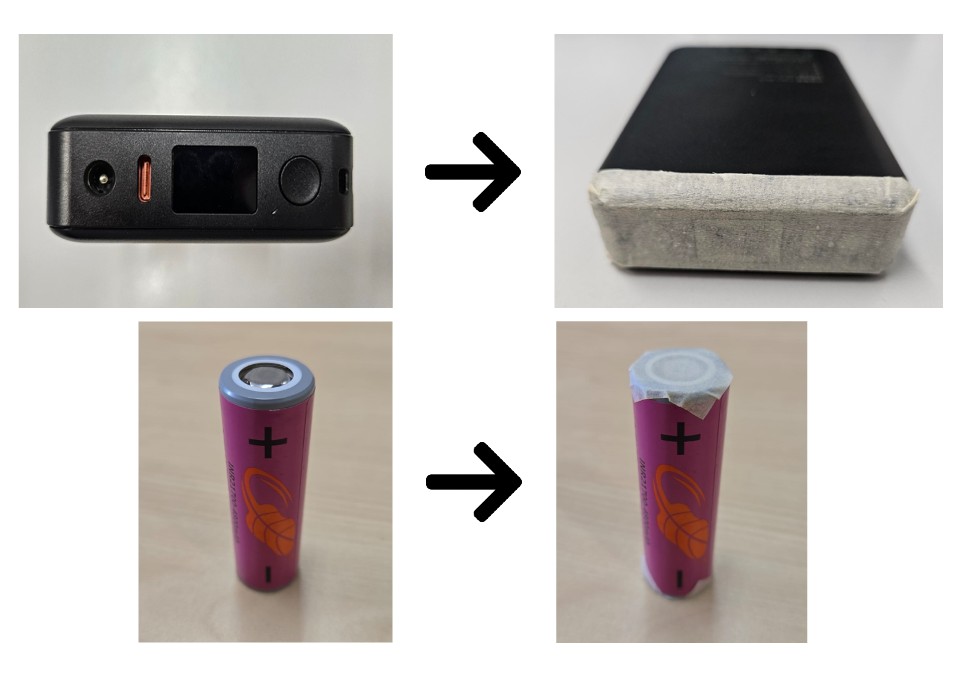
- Take the power bank / rechargeable battery to a battery recycling collection point for recycling.
Recycling collection points for power banks / rechargeable batteries include all MTR stations and McDonald’s. They are also available at some convenience stores, residential estates, commercial buildings, etc. For the detailed locations, please check the recycling interactive map:

For operational considerations, the collection box may not be able to be placed in a prominent location of a Collection Point. Please approach the staff of the respective Collection Point for details.
Enquiry

 Fax: 2915 1410
